


Top 5 Critical PFAS Risks in Agriculture & the Industries Connected to Them
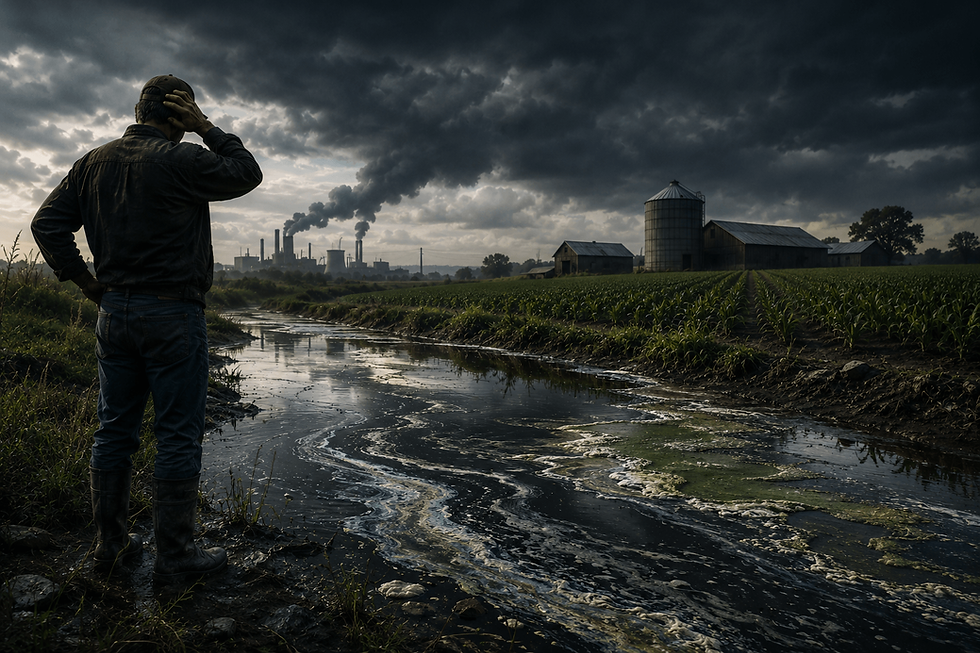
PFAS contamination is no longer only a water-quality issue. It is becoming a major agricultural, food-supply, waste-management, manufacturing, and public-health concern.
Per- and polyfluoroalkyl substances, commonly known as PFAS, are a large class of manufactured chemicals used for their resistance to water, oil, grease, stains, and heat. Their durability has made them valuable across many industries, but it also means that many PFAS persist for long periods in soil, water, wildlife, food systems, and the human body.
For agriculture, the challenge is especially serious because contamination can move through interconnected systems: wastewater, biosolids, irrigation water, farmland, crops, livestock, food processing, and consumer products. Once PFAS enter a farm environment, managing the contamination may be technically difficult, expensive, and disruptive to agricultural production.
Here are five critical PFAS issues shaping agriculture and related industries.
1. PFAS-Contaminated Biosolids Can Turn Farmland Into a Long-Term Contamination Site
Biosolids, treated sewage sludge generated by wastewater-treatment facilities, have historically been applied to agricultural land as a soil amendment or fertilizer. The practice can recycle nutrients and reduce disposal costs, but wastewater treatment may not remove PFAS effectively. As a result, PFAS can remain in biosolids and be transferred to farmland when those materials are land-applied.
This creates a difficult chain of exposure:
Industrial and consumer PFAS use → wastewater → treatment plants → biosolids → agricultural soil → water, crops, livestock, and food
PFAS may persist in soil for long periods, and some compounds can move into groundwater or surface water. Livestock may also be exposed through contaminated grazing land, feed, or water. The result can be a farm-level problem that extends beyond one growing season and may affect agricultural operations, land values, food sales, and rural economies.
The risk is not limited to farmers. Wastewater utilities, municipalities, biosolids processors, fertilizer distributors, food companies, insurers, environmental laboratories, and landowners may all face increased testing, monitoring, liability, or remediation demands.
Critical question: Are biosolids being tested for a sufficiently broad range of PFAS before they are applied to agricultural land?
2. PFAS Can Enter Crops, Livestock, & the Food Supply
Agriculture can become both a recipient and a pathway for PFAS contamination. According to federal agricultural guidance, PFAS may enter farms through contaminated irrigation water, soil amendments, air, or other outside sources. Once present, they may be taken up by crops or enter livestock through contaminated water, feed, or grazing areas.
The movement of PFAS through agricultural systems is complex. It can vary according to:
The specific PFAS compound
Soil characteristics
Water chemistry
Crop species
Livestock exposure
The concentration & duration of contamination
Whether PFAS are more mobile or more likely to accumulate
This complexity makes broad assumptions risky. A farm may require site-specific testing of soil, water, crops, feed, or animal products rather than relying on a single measurement.
For food producers and processors, PFAS concerns may create new pressure for supply-chain documentation and environmental screening. Companies that purchase milk, meat, produce, grain, or other agricultural commodities may increasingly need to understand where products were grown, what inputs were used, and whether contamination risks have been evaluated.
PFAS have been identified as a concern in food and environmental exposure pathways, including fish from contaminated waters and dairy products from exposed livestock.
Critical question: Is food-safety monitoring keeping pace with the growing understanding of PFAS movement through agricultural systems?
3. PFAS in Pesticides & Agricultural Chemicals Raises a New Regulatory Challenge
PFAS concerns are not limited to contamination arriving from outside a farm. Some pesticides and agricultural chemical products may contain PFAS-related substances, while certain pesticide active ingredients may themselves fall within broader scientific definitions of PFAS.
This issue is complicated by differences in how governments, regulators, researchers, and industry organizations define PFAS. A narrow regulatory definition may exclude certain fluorinated chemicals that broader scientific definitions include. As a result, a product may not be labeled or regulated as PFAS under one framework while still being considered part of the PFAS family under another.
For agriculture, this creates several practical concerns:
Could repeated application contribute to long-term soil contamination?
Can certain compounds move into groundwater or surface water?
Are degradation products being evaluated?
Are pesticide labels providing enough information for growers & applicators?
How should regulators assess chemicals designed to remain stable in the environment?
The issue is especially important because agricultural chemicals may be applied repeatedly and across large areas. A substance that is persistent, mobile, or difficult to remove could create environmental consequences that continue long after its intended pest-control function has ended.
Critical question: Should agricultural chemicals be evaluated not only for immediate toxicity, but also for environmental persistence and long-term accumulation?
4. PFAS Exposure Creates Risks Across the Entire Agricultural Supply Chain
PFAS contamination can affect far more than the farm where it is discovered. Agricultural supply chains are highly connected, and contamination concerns may spread through transportation, processing, packaging, distribution, retail, and waste management.
Potentially affected industries include:
Dairy & livestock production
Crop farming & irrigation
Food processing
Animal-feed manufacturing
Fertilizer & soil-amendment production
Wastewater treatment
Biosolids management
Food packaging
Textile & protective-clothing manufacturing
Paper & packaging manufacturing
Chemical manufacturing
Environmental testing & remediation
Agricultural insurance & finance
PFAS have been used in products and industrial processes involving textiles, paper, food packaging, electronics, chemical manufacturing, and other sectors. For businesses, the concern is increasingly operational as well as environmental. Companies may face questions involving supplier verification, product testing, contractual liability, regulatory compliance, consumer trust, and environmental disclosure.
A contamination event can also create uncertainty for farmers who depend on the ability to sell crops or animal products. If testing identifies PFAS, producers may face lost revenue even when they did not manufacture, use, or knowingly introduce the chemicals.
Critical question: Who bears the financial responsibility when PFAS enters a farm through contaminated inputs originating elsewhere?
5. PFAS Remediation & Prevention May Become One of Agriculture’s Largest Environmental Challenges
PFAS are often called “forever chemicals” because many are highly persistent and break down slowly. Their chemical properties can make conventional environmental cleanup methods difficult or costly.
For contaminated agricultural land, there may be no single solution. A response could involve some combination of:
Soil & water testing
Source identification
Restrictions on contaminated inputs
Crop or livestock monitoring
Water treatment
Containment or removal of contaminated materials
Changes in land use
Long-term environmental monitoring
However, testing itself presents challenges. There are thousands of PFAS; analytical methods may target only selected compounds, and laboratory results can depend on the sampling method and the specific chemicals being measured.
Prevention may therefore be more practical and less expensive than attempting to remediate widespread contamination after it occurs. Stronger source control, improved industrial discharge management, transparent chemical reporting, safer product design, and careful screening of agricultural inputs could reduce the likelihood that PFAS enters farmland in the first place.
The agricultural sector may also need clearer policies for affected producers, including testing assistance, technical guidance, financial support, market protections, and scientifically grounded thresholds.
Critical question: Are governments and industries investing enough in prevention, monitoring, and farmer support before PFAS contamination becomes more widespread?
PFAS is emerging as a cross-industry challenge with consequences that may extend from factories and wastewater systems to farmland, food products, and consumers.
The five most critical issues are:
PFAS-contaminated biosolids may introduce persistent chemicals into agricultural soil.
PFAS can move through crops, livestock, water, & food-production systems.
PFAS-related concerns in pesticides & agricultural chemicals raise difficult regulatory questions.
Contamination can affect the entire agricultural supply chain, not only individual farms.
Testing, cleanup, liability, & prevention may require long-term investment & coordinated action.
The most effective response will likely require collaboration among farmers, agricultural businesses, wastewater utilities, chemical manufacturers, food companies, researchers, regulators, and communities. The goal should not be limited to detecting PFAS after contamination occurs.
It should include preventing new releases, improving transparency, supporting affected producers, and reducing the likelihood that persistent chemicals continue moving through agricultural and food systems.
Editorial note: PFAS science and regulation continue to evolve. This article is intended for educational and industry-awareness purposes and should not be treated as legal, regulatory, medical, or site-specific environmental advice.
Sources & Further Reading
U.S. Environmental Protection Agency: PFAS Overview
U.S. Environmental Protection Agency: Current Understanding of Human Health and Environmental Risks of PFAS
https://www.epa.gov/pfas/our-current-understanding-human-health-and-environmental-risks-pfas
U.S. Environmental Protection Agency: PFAS Explained
Farmers.gov PFAS: Agricultural Background, Risks, and Resources
European Food Safety Authority: PFAS and Food Safety
https://www.efsa.europa.eu/en/topics/per-and-polyfluoroalkyl-substances-pfas
U.S. Department of Energy: PFAS Information and Environmental Impacts
https://www.energy.gov/pfas/pfas-and-polyfluoroalkyl-substances


