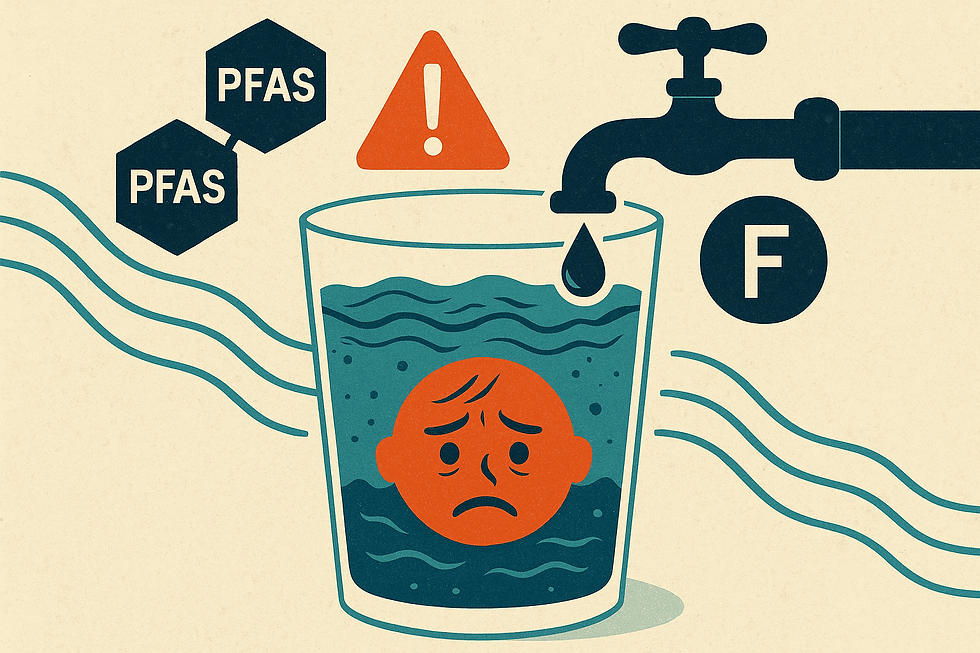
Is PFAS Actually Being Removed in the U.S.?
How far we’ve come & what still needs to happen

What Are PFAS & Why Do They Matter
Per- and polyfluoroalkyl substances (PFAS) are a large group of synthetic chemicals used for decades in industrial processes and everyday products like non-stick cookware, stain-resistant fabrics, and firefighting foams. Because of their unique chemistry, PFAS don’t easily break down in the environment or in people’s bodies, earning them the nickname “forever chemicals.”
Their widespread presence and links to serious health effects (including impacts on newborn health, immune response, and cancer risk) make them a key priority for environmental regulation and cleanup.
The U.S. Is Much Better at Detecting PFAS, But That’s Just Step One
Historically, the U.S. lacked reliable nationwide data on PFAS in drinking water. That changed with the EPA’s latest monitoring efforts under the Fifth Unregulated Contaminant Monitoring Rule (UCMR-5), which expands testing for dozens of PFAS across thousands of public water systems.
This effort gives scientists and regulators their best national picture yet of where PFAS occur, a crucial first step in removal. Thanks to this data, the EPA has also moved forward with legally enforceable drinking water standards for several PFAS, aiming to lower human exposures in millions of communities.
Proven PFAS Removal Technologies: What Works
EPA and independent research show that PFAS can be removed from water using existing technologies. Here are the most effective methods currently in use:
Granular Activated Carbon (GAC)
One of the most widely used technologies, GAC adsorbs many long-chain PFAS as water passes through it. It’s especially effective for legacy compounds like PFOA and PFOS, but it doesn’t destroy the chemicals; it just traps them.
Ion Exchange Resins (IX)
These systems can be highly effective for PFAS removal, often outperforming GAC, and are already in use at many utilities. Like GAC, they capture PFAS rather than break them down.
Reverse Osmosis (RO) & Other Membranes
High-pressure membranes, including RO, can reject a wide range of PFAS molecules, often removing over 90% of them from water. However, this method produces a concentrated waste stream that still contains the PFAS.
Bottom line: These technologies do a strong job of separating PFAS from water, but none of them fully destroy the chemicals at scale, which means the PFAS end up concentrated in residual waste.
What Happens to PFAS After Removal: The Disposal Challenge
Here’s where the story gets complicated: removing PFAS from water isn’t the same as destroying them everywhere. Most capture technologies produce spent media (used carbon or resins) or concentrated brine (from membrane systems). That material must be disposed of or treated, and traditional disposal (like landfilling) can leave the chemicals in the environment where they could re-enter water, soil, or air.
To guide responsible waste management, the EPA updated its Interim Guidance on the Destruction and Disposal of PFAS in 2024. The guidance highlights currently available large-scale options, like thermal destruction and underground injection, but also emphasizes uncertainties and data gaps in understanding how to do this safely and effectively.
Emerging Technologies: The Cutting Edge of PFAS Destruction
Scientists and companies are rapidly developing next-generation PFAS destruction techniques with the goal of breaking the chemicals down completely rather than just moving them around:
Thermal (High-Temperature) Destruction & Combustion — Used in some contaminated soil and media treatment, but effectiveness can depend heavily on operating conditions.
Electron Beam & Advanced Oxidation Technologies — Research and pilot projects (including government-supported efforts) are testing electron beam and other energy-driven methods to break carbon-fluorine bonds in PFAS.
Electrochemical & Sonolysis Approaches — Investigational systems use sound waves or electrical fields to decompose PFAS in water or extracted waste streams.
These innovations are promising but not yet widespread, and many are still in pilot stages or early commercialization. Widespread, cost-effective PFAS destruction remains a major research and infrastructure challenge.
Practical Results: What Utilities Are Actually Doing Today
Across the U.S., utilities impacted by PFAS contamination are actively installing GAC, IX, and membrane systems to comply with new regulatory standards and protect local water supplies. Federal funding through infrastructure bills has helped accelerate this work.
Yet for many systems, especially in smaller or underfunded communities, installing and maintaining advanced treatment is expensive and technically complex. Even when systems are in place, questions remain about how securely the spent PFAS-laden waste is managed.
Progress, But Not a Final Fix
Successes so far include:
Better nationwide detection & monitoring of PFAS.
Deployment of technologies that effectively remove PFAS from drinking water supplies.
Federal guidance & funding for cleanup & waste management.
Remaining challenges:
True, permanent destruction of PFAS at scale, not just removal, is still emerging and not yet routine.
Disposal practices like landfilling or storage can leave PFAS lingering in the environment if not paired with destruction technologies.
Cost, technical complexity, & uneven implementation mean results vary widely across regions & utility sizes.
The good news? Innovation is accelerating, and regulatory frameworks are tightening. But widespread, cost-effective PFAS elimination, not just temporary sequestration, remains a work in progress.
Want to Understand What This Means for Your Water?
Ask your local utility:
Has UCMR-5 monitoring been completed for your system?
What treatment technology is in place for PFAS removal?
How is spent media or concentrated waste managed or destroyed?
Knowing the answers will help you understand not just whether PFAS are being removed, but how responsibly they’re being handled once captured.
Sources
Government & Regulatory:
EPA’s PFAS Strategic Roadmap detailing action and progress on PFAS monitoring, cleanup, and disposal. (EPA) — https://www.epa.gov/system/files/documents/2024-11/epas-pfas-strategic-roadmap-2024_508.pdf EPA
EPA’s analysis of drinking water treatment technologies that remove PFAS. (EPA) — https://www.epa.gov/sciencematters/reducing-pfas-drinking-water-treatment-technologies EPA
2024 Interim Guidance on PFAS destruction and disposal. (EPA) — https://www.epa.gov/pfas/interim-guidance-destruction-and-disposal-pfas-and-materials-containing-pfas EPA
EPA news release on updated interim destruction/disposal guidance. (EPA) — https://www.epa.gov/newsreleases/epa-releases-updated-interim-guidance-destroying-and-disposing-certain-pfas-and-pfas EPA
EPA’s press on PFAS drinking water standards and investments. (EPA) — https://www.epa.gov/newsreleases/biden-harris-administration-makes-unprecedented-progress-protect-communities-pfas EPA
EPA release on UCMR-5 PFAS monitoring expansion. (EPA) — https://www.epa.gov/newsreleases/epa-delivers-results-pfas-action-plan EPA
Scientific & Technology Reviews:
7. Academic review of membrane efficiency and challenges in PFAS removal. (MDPI) — https://www.mdpi.com/2077-0375/12/7/662 MDPI
8. Coverage of emerging PFAS destruction technologies and research trends. (Various) — ongoing developments in pilot projects and advanced treatments. Tetra Tech
Health Context:
9. Recent study linking PFAS drinking water to infant mortality and birth outcomes. (The Guardian) — https://www.theguardian.com/us-news/2025/dec/08/drinking-water-pfas-infant-mortality-study