


The Science Behind Sand Media Filtration
- Aug 5
- 6 min read

Water rarely travels alone. It can carry fine sediment, organic debris, algae, mineral particles, and other materials that may be nearly invisible but still capable of disrupting the systems that depend on a steady flow. Before water reaches an irrigation line, industrial pump, treatment plant, or commercial facility, those particles may need to be removed. One of the most enduring ways to do that is through sand media filtration.
The idea is straightforward: direct water through a carefully prepared bed of granular material and allow the media to capture suspended particles. The technology predates modern sensors, automated controls, and advanced filtration membranes, yet it remains widely used because it can handle large volumes of water and adapt to many operating conditions. Its simplicity, however, can be misleading.
A sand media filter is not merely a tank filled with sand. It is an engineered system in which water flow, pressure, media size, bed depth, particle characteristics, and maintenance practices work together. Small changes in any of these factors can affect how efficiently the filter performs.
A Landscape of Tiny Pathways
Inside a sand media filter, water moves through a network of narrow spaces between individual grains. Those spaces form a complex pathway that allows water to pass while increasing the chances that suspended material will be captured.
Some particles are stopped because they are larger than the openings within the media. Others collide with the grains, become lodged in small spaces, or attach to the surfaces of the material. Filtration does not occur at only one layer.
Larger particles may collect near the top of the media bed, while smaller particles can travel deeper before becoming trapped. This creates a three-dimensional filtering environment rather than a single barrier.
The size of the media plays an important role. Fine grains create smaller openings and may capture smaller particles, but they can also slow water movement and increase resistance. Larger grains allow water to move more easily but may provide less control over fine material. Engineers must balance these effects when designing a system.
Media depth also influences performance. A deeper bed can provide more opportunities for particles to be captured, but it may increase pressure loss. The goal is to create enough contact between the water and the media without requiring excessive energy to maintain flow. Because water sources vary, there is no single design that works everywhere.
Groundwater may contain fine mineral particles. Rivers and reservoirs can carry sediment, algae, and organic matter. Agricultural runoff may introduce additional material, while seasonal storms can rapidly change the amount of debris entering a system. The water itself helps determine how the filter should be built.
Why Invisible Particles Matter
Water does not need to look cloudy to create operational problems. Fine particles can remain suspended in apparently clear water and gradually collect inside pipes, valves, nozzles, and other equipment. Their effects may be slow and difficult to detect.
In irrigation systems, the consequences can be especially significant. Drip emitters are designed to release precise amounts of water. When sediment or organic material accumulates inside them, flow can become restricted. Some areas may receive less water than intended, while other sections continue operating normally.
The result can be uneven irrigation that affects water efficiency and plant growth.
Industrial systems face different challenges. Suspended material may contribute to equipment wear, interfere with heat transfer, or reduce the effectiveness of later treatment stages. Particles can also accumulate in pumps and valves, increasing maintenance needs. Filtration is therefore more than a method for improving water clarity.
It can act as a protective layer for the infrastructure that moves and uses water. Removing suspended material early may reduce clogging, limit wear, and support more consistent system performance.
When the Filter Needs Cleaning
A filter cannot capture particles indefinitely. As debris accumulates inside the media bed, water encounters increasing resistance. The pressure difference between the inlet and outlet may rise, and the system may require more energy to maintain the desired flow. Eventually, the filter must be cleaned.
Sand media systems commonly use backwashing to restore performance. During normal operation, water moves through the filter in one direction. During a backwash cycle, the flow is reversed. Water moves upward through the media, loosening trapped particles and expanding the filter bed. The released material is carried away through a waste line.
After the cycle is complete, the media settles back into place, and the filter returns to normal operation. Backwashing is a central part of the technology, not an occasional repair. Without it, accumulated debris could compact the media, restrict flow, and reduce the filter’s ability to capture additional particles. Over time, poor cleaning could also create uneven pathways through the bed.
Many systems automate the process. Some begin backwashing according to a schedule. Others monitor pressure and initiate cleaning when the difference between the inlet and outlet reaches a selected threshold. The appropriate frequency depends on the source water.
A system supplied by relatively clear groundwater may require less frequent cleaning than one treating water from a sediment-rich river. Storms, seasonal runoff, algae growth, and changes in demand can also affect how quickly a filter becomes loaded.
The Engineering Beyond the Sand
The filter media receives much of the attention, but the surrounding equipment is equally important. Water must be distributed evenly across the media bed. If flow concentrates in a limited area, it may create preferred pathways through the filter.
This process is called channeling. When channeling develops, some water can move through the media too quickly, reducing the opportunity for particles to be captured. Other areas may receive little flow and contribute less to the filtration process. Internal distribution systems are designed to reduce this risk. They help spread incoming water across the bed and support an even flow during backwashing.
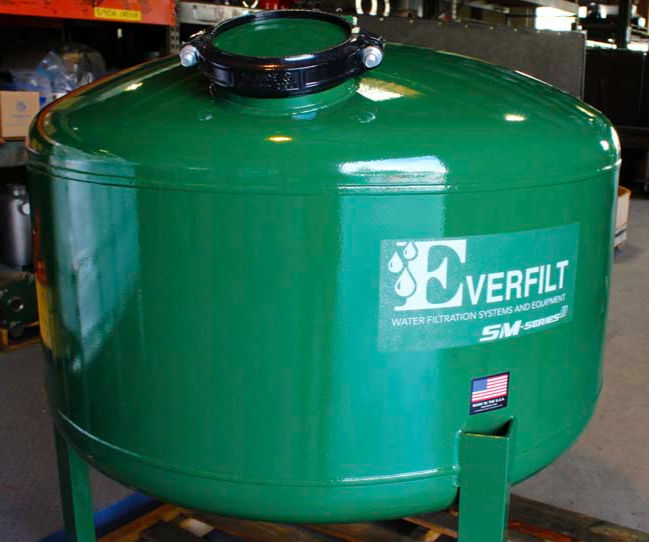
The filter vessel must also withstand pressure, moisture, and changing water conditions.
Materials may be selected according to water chemistry, operating pressure, environmental exposure, and expected service life. Corrosion resistance can be important when equipment operates outdoors or handles chemically challenging water.
The system must balance several demands at once: effective filtration, reliable water movement, structural durability, and manageable maintenance.
How Filter Media Changes
Sand and other granular materials can remain in service for years, but they gradually change. Repeated backwashing may cause physical wear. Minerals can form deposits on the grains. Organic material and biological growth may accumulate inside the bed. Fine particles can settle into spaces that are difficult to clean.
These changes may affect both flow and filtration. Rather than relying only on a fixed replacement schedule, operators often monitor the behavior of the system. Increasing pressure differences, reduced flow, more frequent backwashing, or changes in filtered water quality may indicate that the media or equipment needs attention.
Routine inspections can also reveal uneven media depth, compaction, channeling, or damage to internal components. Regular monitoring helps identify gradual problems before they lead to reduced performance or unexpected downtime.
From Farms to Water Infrastructure
Sand media filters are often associated with agricultural irrigation, but their applications extend far beyond farms. In agriculture, they can help protect drip lines and irrigation emitters from sediment and organic debris. Greenhouses and nurseries may use filtration to support more consistent water delivery.
Landscape and turf systems can also benefit from reducing the material entering large irrigation networks. Industrial facilities may use media filters before water reaches sensitive equipment or enters another treatment stage. Commercial and municipal systems may incorporate them into larger water-management processes.
In many installations, sand media filtration is only one part of a treatment system.
Water may first pass through screens that remove larger debris. It may then move through media filters, cartridge filters, membranes, or other technologies. Chemical treatment and disinfection may be added when the water must meet specific quality requirements.
Each stage addresses a different challenge. Sand media filters are primarily designed to reduce suspended material. They are not intended to remove every dissolved chemical, salt, microorganism, or extremely small particle. Additional treatment may be necessary when those contaminants are present.
Why an Old Idea Still Matters
Sand media filtration has endured because its underlying principle remains useful.
The systems can be adapted to different water sources, scaled for varying flow demands, and integrated with automated controls. Their operation is well understood, and their maintenance can be planned around the conditions of the water being treated.
Their value does not depend on novelty. It comes from dependable performance and the ability to protect the equipment connected to a water system. As agriculture, industry, and communities face increasing pressure to manage water efficiently, reliable filtration will remain important.
Modern water systems may be more complex than those of the past, but the central challenge is familiar: move water where it is needed while limiting the problems caused by the material carried within it. Sand media filtration addresses part of that challenge through a physical process refined by engineering.


